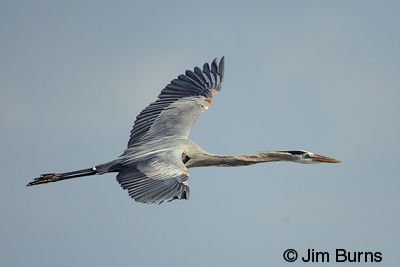
When you see a great blue heron overhead, do you think about the wonder of flight, or do you see a giant flying reptile, pterodactyl-like, huge head suspended on long, thin neck, seeking its next prey? When you see a cactus wren in your yard, do you think cute little state bird of Arizona, or do you see a feathered lizard, walking upright with measured reptilian gait, stalking its next meal?
Conventional scientific thinking over the past several decades told us that birds evolved from dinosaurs. An exhibit now at AZMNH, "Feathered Dinosaurs and the Origins of Flight," suggests otherwise. On loan from the Republic of China, some of the 35 remarkable fossils in the display preserve not only bones, but the impressions of feathers. They imply there may be different answers than we thought to two long intriguing questions about the relationship between dinosaurs and birds.
Did dinosaurs and birds evolve from a common ancestor? Did flight originate from the ground up or from the trees down? Feather impressions found in the fossils of both flying reptiles and theropod dinosaurs indicate that the ability to fly rather than feathers themselves are really the defining characteristic of "bird." The evidence of long claws indicates a "climbing wing" in the ancestors of birds and suggests that the ability to perch may have predated the ability to fly. If so, structural features common to both dinosaurs and birds evolved not because of common ancestry, but through convergence, "a condition where similar characteristics evolve independently."
There are fossils with huge heads and jaws replete with rows of teeth. These creatures looked like dinosaurs, but bone structure indicates they were indeed birds, with feathers, which had already lost their ability to fly. There are fossils with flight feathers on their hind legs. These too had the appearance of dinosaurs, but bone structure reveals four wings and the ability to fly. There are fossils with long, reptilian tails. Bone structure says they too could fly.
This exhibition will give you a greater understanding of how scientists recreate evolution and classify creatures into families. And you will never look at a bird again in the same way. They are beautiful and so much more, with a millions-of-years history of adaptation and survival which continues to this day. They are an ancient thread in the complex tapestry of life in which we represent a relatively new warp and weft.